


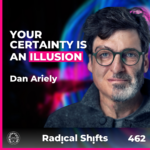

What if the voice you’ve been trusting your entire life was never qualified to guide you? What if every snap judgment you’ve ever made about a person, a relationship, or a career was based on a feeling that never had enough information to be accurate? What if the very thing you call intuition is actually your biggest blind spot?
In this extraordinary episode, world-renowned behavioural economist Dan Ariely reveals why we place enormous trust in a gut feeling that has rarely been tested and almost never earned. From his deeply personal story of spending nearly three years in a hospital burn ward, Dan traces a lifetime of research into why human beings consistently follow instincts that lead them in the wrong direction, and what we can do instead to make decisions that actually serve us.
This is for anyone who has ever wondered why they keep repeating the same patterns despite knowing better.
The Burn Ward Where It All Began
Dan’s journey into understanding irrationality started with pain. Burned across 70% of his body, he spent years watching nurses rip his bandages off quickly, convinced they were being kind. Dan felt otherwise. Years later, he tested their approach scientifically and discovered they were wrong. Pain is far more sensitive to intensity than duration. A slower approach would have caused significantly less suffering. The nurses were not cruel. They were following their intuition. And their intuition had failed them.
This became the foundation of Dan’s life’s work: identifying the places where we believe we are doing the right thing, but our instincts are quietly steering us in the wrong direction.
Why Your Gut Feeling Has Not Earned Your Trust
Dan explains that reliable intuition only develops under very specific conditions: repeated experience with slight variation and immediate, clear feedback. A basketball player adjusting each throw. A chess master reading patterns over thousands of games. But in the areas that matter most to our lives, from choosing a partner to evaluating a new job to trusting a stranger online, we simply do not have enough data points. We have lived in a handful of houses, held a handful of jobs, dated a handful of people. That is nowhere near enough to build a trustworthy instinct, yet we treat these feelings as gospel.
He shares a remarkable study where participants were asked to identify their closest friends from a list of 40 people described only by their characteristics, with no names or photos. The result? People were terrible at it. The feeling of knowing who we connect with did not match reality at all.
The Beliefs You Inherited but Never Questioned
Perhaps the most confronting section of the conversation comes when Dan reveals how many of our deepest values were simply handed to us. Through his work speaking directly with people who hold extreme views, he found that when asked where their beliefs originated, most traced them back to a single comment heard in childhood. They had carried it for decades without ever testing it.
He extends this to everyday life. Ask someone about their position on any deeply held topic, then ask what they have actually read about it. The answer, more often than not, is very little. Our confidence in our own opinions far exceeds our knowledge, a phenomenon Dan calls the illusion of explanatory depth.
Key Takeaway
Your intuition is not worthless, but it is wildly overvalued. The path to better decisions is not about thinking harder. It is about slowing down, suspending judgment, and building the intellectual humility to admit you might be wrong. When you give yourself advice as though you were guiding a friend, think long-term instead of reacting to the moment, and create rituals that force you to pay attention, you stop being a passenger in your own decision-making and start becoming the driver.
Watch the full conversation on YouTube.
Find Out More About Dan Ariely
Website: danariely.com
Facebook: danariely
Instagram: @danariely
YouTube: danariely
LinkedIn: danariely