

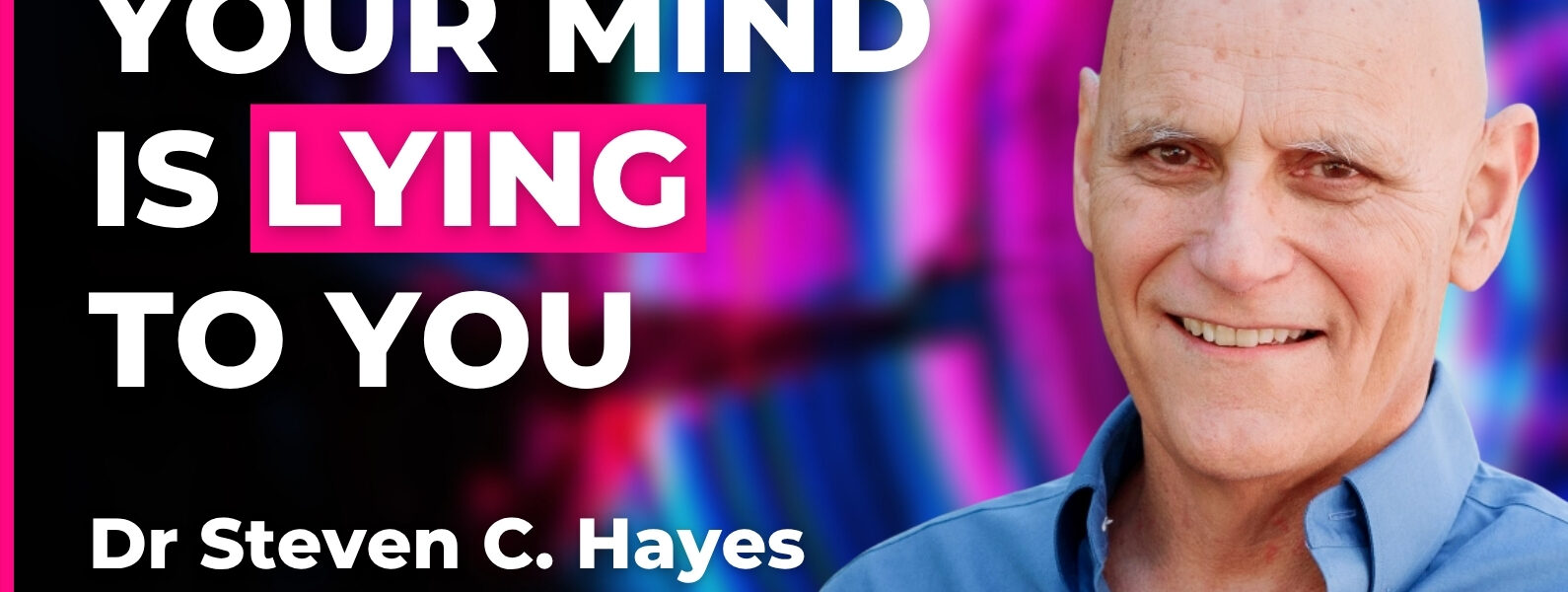

For most of us, the mind feels like the most trustworthy part of who we are. It’s the voice that plans, decides, judges, remembers, and tells us who we are. But what if that voice isn’t quite the friend we thought it was? What if the very organ we rely on to solve our problems is the same one quietly creating most of them?
In this powerful episode, world-renowned psychologist Dr Steven C. Hayes, the founder of Acceptance and Commitment Therapy (ACT), shares 50 years of research distilled into one life-changing conversation. What emerges is nothing short of a new way to relate to your thoughts, your pain, and your life.
The Misery That Started It All
Dr Hayes didn’t come to this work through theory. He lived it. Growing up, he watched two loving parents trapped in their own suffering, his father struggling with alcoholism, his mother with OCD and depression. As a child, he had thoughts like “I’m not going to make it out of here alive.” That experience sparked a lifelong question: what is the smallest set of things that does the most good for the most people?
Fifty years and nearly 1,500 randomised trials later, he has an answer.
The One Sentence That Took 50 Years to Write
“Life is asking you to learn how to be more open, aware, and actively engaged in a meaningful life while scaling that to your relationships and your body.”
That’s it. One sentence that, according to Dr Hayes, summarises the entire world’s literature on psychological change. Open means emotionally and cognitively flexible. Aware means able to direct your attention with intention rather than being hijacked by every passing thought. Actively engaged means connecting to what genuinely matters and building habits around it.
Why You Need to Put Your Mind on a Leash
Here’s where it gets fascinating. Dr Hayes explains that the human mind can relate anything to anything else in infinite ways. The mathematical potential of your thoughts exceeds the number of molecules in the universe. And yet most of us fall into the same narrow ruts: “I’m not good enough.” “It’ll never work out.” “I’m unlovable.”
“We better learn to put your mind on a leash,” he says. “If you have a mind with infinite capacity, that’s wonderful. But if you’re going to learn to use it without having it use you, you better learn how to put it on a leash.”
Pain Is Not Your Enemy
One of the most powerful threads of the conversation is Dr Hayes’ distinction between pain and suffering. Pain, he explains, is not optional. Love and loss are one thing, not two. But suffering is different. It comes from the act of carrying pain rather than letting it walk alongside you. And the more we try to avoid pain, the heavier the suffering becomes.
“You had the pain, but you’re not having pain about the pain,” he says. “So much of human pain is pain about the pain, added by a problem-solving mind trying to turn your life into a problem to be solved instead of a process to be experienced. Once you’re there, you’re doomed, because you’re more like a sunset than you are a maths problem.”
You Are More Unique Than Your Fingerprint
Dr Hayes also offers a beautiful reframe on your own uniqueness. Your fingerprint alone is so distinct that if every grain of sand on Earth were a fingerprint, it would take more than a million Earths to find a match. Now multiply that by your memories, your experiences, your emotions, your genetics. You are, in his words, precious to the universe. There is only one person like you.
Key Takeaway
The reason your mind feels like it’s running your life is because, unchecked, it will. But your thoughts are not the truth, pain is not the enemy, and healing doesn’t mean erasing what hurts. It means becoming whole enough to carry it lightly. When you learn to put your mind on a leash, feel what’s real, and engage with what actually matters, you finally stop living as a problem to be solved and start living as a life to be experienced.
Watch the full conversation on YouTube.
Find Out More About Dr Steven C. Hayes
Website: www.stevenchayes.com
Facebook: @drstevenchayes
Instagram: @drstevenchayes
YouTube: @StevenCHayes
LinkedIn: Steven C. Hayes